Với hơn 10 năm kinh nghiệm về vận chuyển khí nén, Headpowder Sơn Đông cung cấp hệ thống, thiết bị và quạt gió toàn chuỗi, đảm nhận các dự án kỹ thuật bột trọn gói trên toàn quốc.
Calcium carbonate (CaCO₃) is a widely used industrial material, essential in applications ranging from construction to plastics and coatings. The efficient and reliable transportation of this material from storage to processing units is critical for maintaining production efficiency and product quality. Various conveying methods are employed in industrial settings, each with distinct advantages and limitations. This article provides a detailed comparison of common calcium carbonate conveying methods, focusing on their operational principles, suitability for different applications, and key considerations for selection.
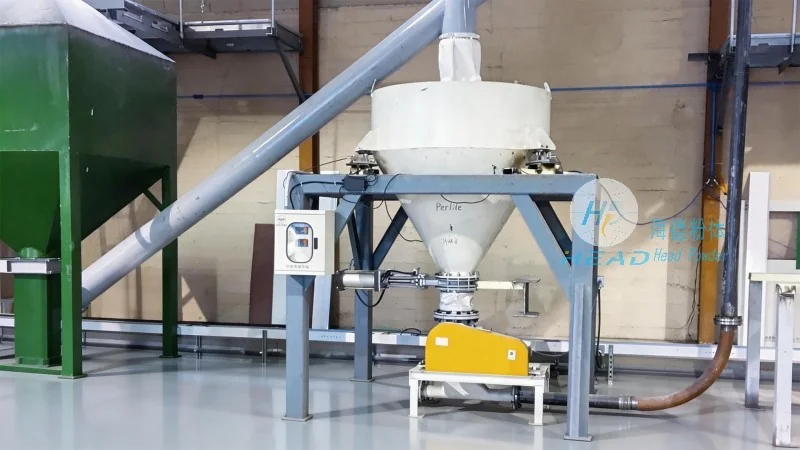
1. Screw Conveyors (Auger Conveyors)
Screw conveyors, also known as auger conveyors, are among the most common equipment for moving bulk materials like calcium carbonate. These systems consist of a rotating helical screw blade enclosed in a U-shaped or tubular housing. As the screw rotates, it pushes material forward along the conveyor. Screw conveyors are particularly effective for horizontal or slightly inclined transport and are well-suited for handling dry, free-flowing powders and granules. They offer advantages such as compact design, low maintenance, and the ability to handle materials with varying moisture content. However, they may struggle with highly abrasive or sticky materials, which can cause wear on the screw and housing. The throughput of screw conveyors is generally lower compared to other methods, making them ideal for moderate production rates. For calcium carbonate applications, screw conveyors are often used in feed systems, blending operations, and material transfer between storage silos and processing equipment.
2. Pneumatic Conveying Systems
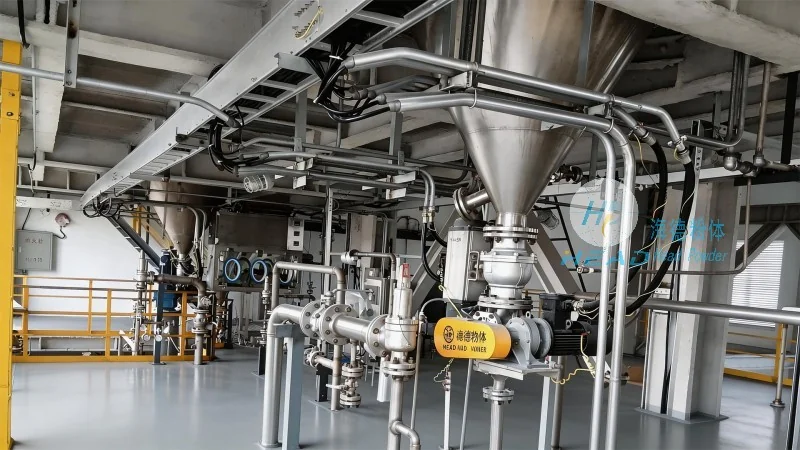
Pneumatic conveying systems use air or other gases to transport calcium carbonate particles through a pipeline. These systems can be categorized into two main types: dilute-phase and dense-phase. Dilute-phase systems operate at higher air velocities, typically moving material in a dispersed state, while dense-phase systems use lower air velocities to form a slurry-like mixture of material and air. Pneumatic conveying offers several benefits, including the ability to transport materials over long distances (up to several hundred meters) and vertical lifts, as well as the flexibility to integrate with existing processing lines. This method is particularly advantageous for handling fine powders that are prone to dust and for applications requiring dust-free or enclosed transport. However, pneumatic systems can be energy-intensive, especially for dense-phase operation, and may require more complex control systems to manage air pressure and flow rates. Additionally, the design of the system must account for material properties, such as particle size and moisture content, to prevent blockages or excessive wear on the pipeline and valves.
3. Hydraulic Conveying (Slurry Pumps)
Hydraulic conveying, or slurry pumping, involves transporting calcium carbonate suspended in a liquid medium, typically water or a process fluid. This method is commonly used for materials that are difficult to handle dry, such as wet or sticky calcium carbonate. Slurry pumps, including centrifugal and positive displacement types, are used to move the slurry through pipelines. Hydraulic conveying offers high throughput and the ability to transport materials over long distances, including vertical lifts. It is particularly effective for applications where the material is already in a slurry form, such as in mining or mineral processing operations. However, this method requires additional equipment for slurry preparation and dewatering, increasing operational complexity and cost. The presence of liquid in the system can also lead to issues with corrosion and material degradation over time. Furthermore, the density and viscosity of the slurry must be carefully managed to ensure efficient pumping and prevent pipeline blockages.
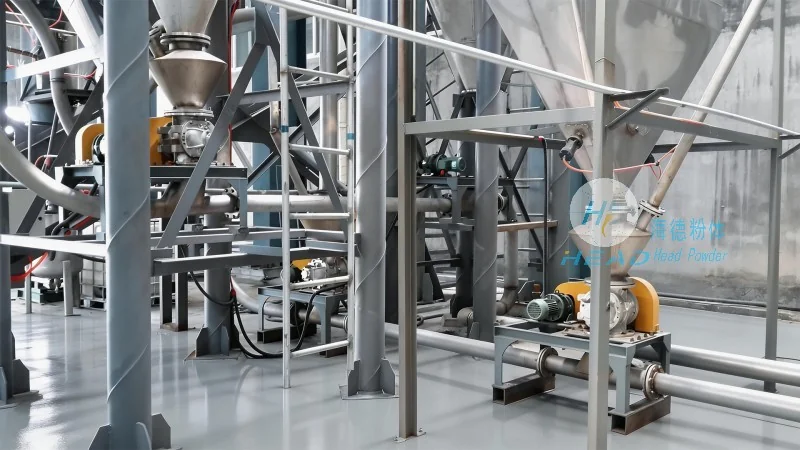
4. Belt Conveyors
Belt conveyors are another widely used method for transporting bulk materials, including calcium carbonate. These systems consist of a continuous belt that moves over rollers or pulleys, carrying material from one point to another. Belt conveyors are suitable for both horizontal and inclined transport and can handle a wide range of material types, from fine powders to large lumps. They offer high throughput and are relatively simple to operate and maintain. However, belt conveyors require significant space and may not be suitable for vertical lifts or long horizontal distances without intermediate supports. The design must consider factors such as material abrasiveness, which can cause wear on the belt and pulleys, and the need for proper tensioning and alignment to prevent slippage or belt failure. For calcium carbonate applications, belt conveyors are often used in feed systems for large-scale processing plants or in material transfer between storage and processing areas.
5. HeadPowder's Comprehensive Conveying Solutions
Shandong HeadPowder Engineering Co., Ltd. (headpowder) specializes in providing tailored conveying solutions for calcium carbonate and other bulk materials. With years of experience in the industry, headpowder offers a range of equipment and services designed to optimize material handling processes. The company’s expertise includes the selection and integration of appropriate conveying systems based on specific application requirements, such as material properties, production capacity, and operational environment. headpowder’s solutions may include custom-designed screw conveyors, pneumatic systems, or hydraulic setups, ensuring that clients achieve efficient, reliable, and cost-effective material transport. By leveraging advanced engineering and material handling technologies, headpowder helps industries improve productivity, reduce downtime, and enhance overall operational efficiency. The company’s commitment to quality and customer satisfaction makes it a trusted partner for businesses seeking to enhance their calcium carbonate conveying processes.

 Shandong Headpowder Engineering Co., Ltd.
 156-6277-7102(Quản lý Trương)
  0531-83386006
  Thành phố Tế Nam, Tỉnh Sơn Đông, Trung Quốc
Điện thoại
WeChatTư vấn
Lên đầu